$ 660,000 M
Combined hyperscaler capex for AI in 2026
Profitability
660 billion in infrastructure, only 5% of companies with real ROI, and a track record of expectations that always outpace reality
In the first quarter of 2026, four funding rounds — OpenAI, Anthropic, xAI, and Waymo — absorbed 65 % of all global venture capital. The hyperscalers have committed more than 660 billion dollars in infrastructure for this year. And 95 % of companies adopting generative AI see no measurable return.
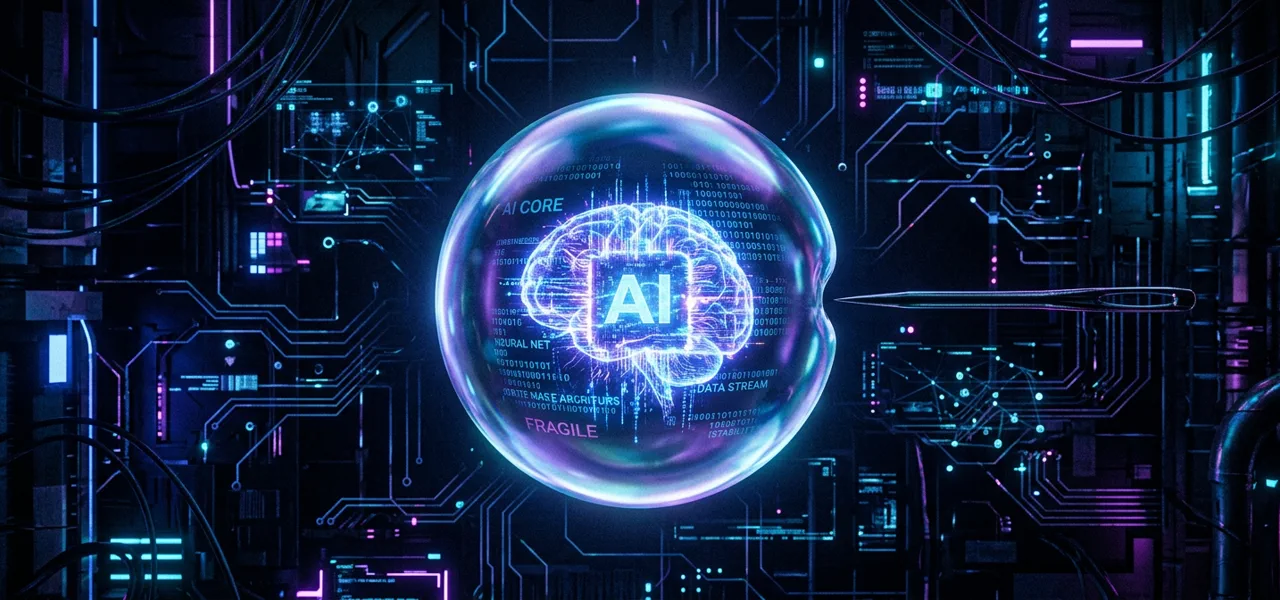
AI is not a simple or uniform bubble. The technology is real, the leaders' revenues are real, and the mass adoption is unprecedented. But private valuations, capex running ahead of proven demand, capital circularity among the same players, and the gap between adoption and real economic impact present classic bubble signals in specific market segments.
$ 660,000 M
Combined hyperscaler capex for AI in 2026
80 %
Of global venture capital went to AI in Q1 2026
5 %
Companies that move beyond the 'experimental pilot' stage with AI
$ 852,000 M
OpenAI post-money valuation (March 2026)
Bubble signals
7
VC concentrated in few players, Extreme private valuations, Capex far ahead of proven ROI, Capital circularity, Low enterprise ROI, Relative technical plateau, Sora as a failed case
Real growth signals
5
Real revenues from leaders, NVIDIA with extraordinary margins, Megacaps with solid balance sheets, Real mass adoption, Coding agents with traction
In the first quarter of 2026, four funding rounds — OpenAI (122,000M), Anthropic (30,000M), xAI (20,000M), and Waymo (16,000M) — absorbed 65% of all global venture capital. Not 65% of tech capital. 65% of all venture capital, across all sectors, across the entire planet.
AI captured 80% of global VC that quarter. Three years ago it was 30%.
The question is not whether there is exuberance. The question is whether it is rational.
The AI of April 2026 is not a simple bubble. It is a real overinvestment in a real technology, but with prices and expectations that, in a significant portion of the market, are already at bubble levels.
The technology works. The leaders’ revenues are real. The mass adoption is unprecedented. But there are three curves advancing at very different speeds: technical improvement, enterprise adoption, and sustainable monetization. And capital is running ahead of all three.
AI is experiencing a selective bubble within a real technological transformation. The risk is not that the technology doesn’t work — it’s that the returns arrive, but too late to justify what has already been invested.
The five major hyperscalers have committed roughly 660 billion dollars in capex for 2026, 36% more than in 2025. Approximately 75% is earmarked exclusively for AI infrastructure:
Capital intensity has reached critical levels: Amazon allocates 57% of its revenue to capex, Meta 52%, Microsoft 48%, Google 45%. In 2025 alone, the sector issued 108 billion in new debt — x3.4 the historical annual average of 32,000M.
The leaders’ revenues are no longer a promise:
But the gap between revenue and valuation is enormous. OpenAI has a run-rate of ~25,000M against a valuation of 852,000M — a multiple of ~x34 on annualized revenue. And it projects losses of 14,000M in 2026, with an expense budget of 38,000M.
The terms of its latest round reveal the fragility: of Amazon’s 50,000M, only 15,000M are unconditional — the remaining 35,000M are contingent on achieving AGI before the end of 2028 or completing an IPO.
The shutdown of Sora 2 on March 24, 2026 is the most important case study of this era.
Bill Peebles, head of Sora, internally admitted in October 2025 that the economics were “completely unsustainable.” The Wall Street Journal described it as “a money pit nobody used.”
Sora proves that impressing is not the same as monetizing. And that the inference cost of the most intensive modalities — video, deep reasoning, autonomous agents — can grow faster than the ability to charge for them.
A significant portion of the AI ecosystem finances itself in a loop:
A CoreWeave default would flood the secondary market with tens of thousands of used GPUs, collapse collateral values, freeze NVIDIA sales, and drag down its stock price.
Capital circularity is not a theory. It is a documented mechanism that simultaneously distorts revenues, demand, and valuations.
This is where the industry narrative collides with the evidence:
NBER (February 2026, 6,000 executives in the U.S., UK, Germany, and Australia): more than 90% reported that AI had no impact on hiring or employment; 89% said the impact on real labor productivity was zero. Executives use AI an average of 1.5 hours per week.
MIT Media Lab (mid-2025): after auditing large corporations, 95% of organizations get zero ROI from generative AI. Only 5% move beyond the “experimental pilot” stage.
S&P Global (451 Research): in March 2025, 42% of companies had to abandon the majority of their AI initiatives — compared to 17% abandonment a year earlier.
And yet, 94% of companies surveyed by BCG and McKinsey say they will continue investing “even if the technology doesn’t generate immediate returns.” The driver is not ROI. It’s FOMO.
The comparison is tempting but imprecise:
| Indicator | Dot-com (1999-2000) | AI (April 2026) |
|---|---|---|
| Leaders’ profits | Very uneven; many with no revenue | Very high at public megacaps |
| P/E of public leaders | Irrational | Elevated but not extreme |
| Private valuations | Disconnected from fundamentals | Yes, especially OpenAI/Anthropic |
| Capex ahead of demand | Very high (telecom/physical internet) | Very high (data centers/AI) |
| Capital circularity | Present | Present in a new form |
| Technological utility | Real but immature | Very real, with current mass usage |
| Marginal cost | Tended toward zero once infra was built | Remains elevated (inference scales linearly with users) |
What does repeat: excess capital deployed ahead of time, infrastructure built before proving returns, infinite TAM narratives, circularity and mutual validation.
What does not repeat: today’s megacaps make a lot of money, the technology already has mass adoption, the product exists and is used daily. As Jerome Powell said in October 2025: “this is different… these companies actually have profits.”
| Scenario | Prob. | Description |
|---|---|---|
| Orderly correction | ~50% | Private valuations drop 25-40%, capex moderates, 2-3 serious restructurings in the middle layer, narrative shifts from “imminent AGI” to “selective monetization” |
| iPhone moment | ~20% | Agents reach sufficient reliability, coding/autonomous workflows become widespread, reasoning gets cheaper, enterprises move from pilot to measurable transformation |
| Severe deleveraging | ~30% | One or more leveraged players experience real financial stress, NVIDIA corrects sharply, open source compresses prices, private markets revalue downward |
The canary in the coal mine is Oracle: BBB rating with a strongly negative outlook, negative free cash flow, leverage >x4 EBITDA projected for three years, and credit default swaps at their highest since 2009. Its stock price has already fallen ~58% from its highs.
If you’re an investor: Don’t confuse “the technology works” with “the investment is good at any price.” The megacaps’ fundamentals are solid, but the private valuations of OpenAI/Anthropic price in years of perfect growth that may not materialize.
If you run a company: Before allocating budget to AI, measure the real ROI — not the theoretical potential. 95% of organizations don’t get past the pilot stage. If your use case has no impact metrics after 6 months, reconsider the scale of the investment.
If you’re a developer: Open source and API price compression are your best allies. DeepSeek-V3.2 operates at $0.028 per million tokens. Flash/lite models cover most use cases. You don’t need the most expensive model for most tasks.
If you work in regulation: Capital circularity in the AI ecosystem is a systemic risk that financial regulators should monitor. A default in the middle layer (CoreWeave, Oracle) can have cascading effects across the entire tech sector.
Related
La brecha entre la inversión en IA y el valor real que genera — y qué pueden hacer las empresas para estar en el 5% que sí funciona
Manifiesto AISHA: por qué defendemos la inteligencia artificial y por qué exigimos que se use de forma responsable
Subscribe to the AISHA editorial newsletter to stay up to date with new pieces, reports and tools.
Go to newsletter